Satish kumar
 At the heart of Camus’ writing lies the concept of the Absurd—the conflict between humanity’s search for meaning and the silent, indifferent universe.
His works continue to resonate deeply in the modern era, especially as readers confront existential questions shaped by technology, isolation, and global crises.
Overview Table
| Attribute | Details |
|---|---|
| Full Name | Albert Camus |
| Born | November 7, 1913 |
| Died | January 4, 1960 (Age 46) |
| Profession | Philosopher, Author, Journalist |
| Nationality | French (born in Algeria) |
| Genre | Philosophy, Fiction, Absurdism |
| Famous For | Absurdism, Existential Themes |
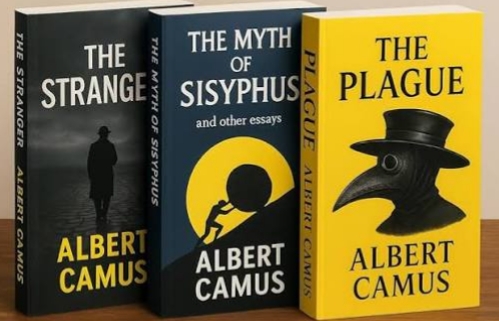
| Major Works | The Stranger, The Plague, The Myth of Sisyphus, The Fall |
| Awards | Nobel Prize in Literature (1957) |
| Estimated Net Worth | Not publicly recorded (literary legacy valued globally) |
Introduction
Albert Camus remains one of the most intellectually compelling writers of the 20th century. His books are not merely literary works—they are philosophical inquiries into the human condition. In a world marked by uncertainty, suffering, and moral ambiguity, Camus offered a perspective that neither surrendered to despair nor relied on false hope.
From The Stranger to The Plague, Albert Camus books are essential reading for anyone interested in philosophy, literature, and the emotional complexity of human life.
Author Biography
Albert Camus was born in French Algeria into a poor working-class family.

His father died in World War I, leaving his mother to raise him in poverty. Despite these hardships, Camus excelled academically and eventually studied philosophy at the University of Algiers.
His early exposure to inequality and colonial tensions deeply influenced his worldview. During World War II, Camus became involved in the French Resistance and worked as a journalist, sharpening his moral and political voice.
In 1957, he was awarded the Nobel Prize in Literature for his contribution to literature and his illumination of “the problems of the human conscience.”
Camus died tragically in a car accident in 1960, leaving behind unfinished works that continue to intrigue scholars.
Key Albert Camus Books
1. The Stranger (1942)
Summary
The Stranger follows Meursault, a detached and emotionally indifferent man who commits a senseless murder. The novel explores his trial, where society judges him more for his lack of emotion than for the crime itself.
Key Themes
- The Absurd
- Emotional detachment
- Meaninglessness of life
- Social judgment
Pros
- Minimalist and powerful prose
- Deep philosophical undertones
- Universally relatable existential themes
Cons
- Emotionally distant protagonist
- Can feel unsettling or bleak
Expert Reviews
Widely considered a masterpiece, critics praise its clarity and philosophical depth. Jean-Paul Sartre described it as a defining work of existential literature.
Reader Impact
Readers often experience a profound shift in perspective, questioning societal norms and personal values.
2. The Plague (1947)
Summary
Set in the Algerian city of Oran, The Plague depicts an outbreak of a deadly disease and the varied human responses to it.
Key Themes
- Human suffering and resilience
- Solidarity vs isolation
- Moral responsibility
Pros
- Rich character development
- Timeless relevance (especially post-pandemic era)
- Emotional and philosophical depth
Cons
- Slow pacing
- Heavy symbolism may feel dense
Expert Reviews
Often interpreted as an allegory for Nazi occupation, the novel has gained renewed attention after COVID-19.
Reader Impact
The book resonates strongly with readers facing modern crises, offering a sense of shared humanity.
3. The Myth of Sisyphus (1942)
Summary
A philosophical essay examining whether life is worth living. Camus uses the Greek myth of Sisyphus to illustrate the absurdity of existence.
Key Themes
- Suicide and meaning
- The Absurd
- Rebellion against meaninglessness
Pros
- Deep philosophical insight
- Thought-provoking arguments
Cons
- Dense and complex
- Not beginner-friendly
Expert Reviews
Considered one of the most important philosophical essays of the 20th century.
Reader Impact
Challenges readers to confront existential questions directly and courageously.
4. The Fall (1956)
Summary
A monologue by Jean-Baptiste Clamence, a former lawyer reflecting on guilt, hypocrisy, and moral decay.
Key Themes
- Judgment and guilt
- Moral hypocrisy
- Self-awareness
Pros
- Intense psychological depth
- Unique narrative style
Cons
- Dark and introspective
- Limited action
Expert Reviews
Praised for its psychological complexity and narrative innovation.
Reader Impact
Encourages introspection about personal morality and hidden flaws.
5. A Happy Death (Published posthumously, 1971)
Summary
An early novel exploring the pursuit of happiness through wealth and freedom.
Key Themes
- Happiness vs morality
- Freedom and choice
Pros
- Insight into Camus’ early thinking
- Simple and reflective
Cons
- Less refined than later works
Expert Reviews
Valued more for its historical significance than literary perfection.
Reader Impact
Offers a softer, more personal perspective on Camus’ philosophy.
Philosophical Analysis
Albert Camus is often associated with existentialism, but he rejected the label. Instead, he defined his philosophy as Absurdism.
Core Ideas:
- Life has no inherent meaning
- Humans naturally seek meaning
- This conflict creates the Absurd
- The solution is not despair, but acceptance and rebellion
Camus argued that one must imagine Sisyphus happy—finding purpose in the struggle itself.
Impact and Legacy
Albert Camus books have influenced literature, philosophy, psychology, and even political thought.
Global Influence
- Studied in universities worldwide
- Referenced in modern psychology and existential therapy
- Adapted into films and plays
Cultural Relevance
In 2026, Camus’ works are experiencing renewed interest due to:
- Rising mental health awareness
- Existential concerns in the digital age
- Post-pandemic reflections
Academic Citations
Camus is frequently referenced in:
- Philosophy journals
- Literary criticism
- Psychological research
Criticism of Albert Camus Books
Despite his acclaim, Camus has faced criticism:
- Philosophical Simplicity: Some critics argue his ideas lack depth compared to Nietzsche or Sartre.
- Colonial Context: His views on Algeria have been debated.
- Emotional Detachment: His characters often lack emotional warmth.
However, these criticisms have also sparked deeper discussions about his work.
Latest Updates (2026)
- New academic interpretations connect Camus’ philosophy with AI ethics and existential risk.
- Modern editions of his works include updated annotations for younger readers.
- His works continue trending on platforms like Goodreads and academic databases.
- Universities are incorporating Camus into interdisciplinary courses (philosophy + technology).
FAQs (Featured Snippet Style)
What are the best Albert Camus books to start with?
Start with The Stranger for fiction and The Myth of Sisyphus for philosophy.
What is Albert Camus best known for?
He is best known for developing the philosophy of Absurdism and writing The Stranger and The Plague.
Is Albert Camus an existentialist?
Camus rejected the label but explored similar themes. He preferred the term Absurdist.
Why is The Plague still relevant today?
Its exploration of human behavior during crises mirrors modern global events like pandemics.
Key Takeaways
- Albert Camus books explore the tension between meaning and meaninglessness.
- His philosophy of Absurdism encourages acceptance and resilience.
- Works like The Stranger and The Plague remain timeless and globally relevant.
- His ideas continue to influence modern thought, especially in uncertain times.
Internal Linking Suggestions
For your website thebooksx.com, consider linking this article to:
- “Top Existential Books You Must Read”
- “Jean-Paul Sartre Books Guide”
- “Philosophy Books That Change Your Life”
- Individual book summaries (The Stranger Summary, The Plague Review)
Final Reflection
Albert Camus did not promise answers. Instead, he offered clarity—a way to face life without illusions. His books do not comfort in the traditional sense; they challenge, provoke, and ultimately liberate.
In a world that constantly demands meaning, Camus reminds us that perhaps the greatest act of courage is to live fully—even when meaning remains uncertain.
Thank you for reading!
Stay tuned for more inspiring Books summary, Author’s spotlight, Trend Books & more get full information on TheBooksx.com
About the Author