George Orwell Books: Summary, Themes & Powerful Lessons You Can’t Ignore
 Satish kumar
 Few writers have shaped modern political thought and language as profoundly as George Orwell.
His works continue to resonate not merely as literature but as warnings—quiet, persistent, and often unsettling. In an age defined by data surveillance, misinformation, and ideological polarization, Orwell’s voice feels less like history and more like prophecy.
Overview Table
| Attribute | Details |
|---|---|
| Full Name | Eric Arthur Blair (George Orwell) |
| Born | June 25, 1903 |
| Died | January 21, 1950 |
| Age at Death | 46 |
| Profession | Novelist, Essayist, Journalist |
| Nationality | British |
| Genres | Political Fiction, Dystopian, Satire, Essays |
| Major Works | 1984, Animal Farm, Homage to Catalonia, Down and Out in Paris and London |
| Net Worth | Not precisely recorded (modest earnings during lifetime) |
| Writing Style | Clear, direct, politically charged, socially conscious |
| Legacy | One of the most influential political writers of the 20th century |
Introduction
George Orwell’s books are not simply stories. They are frameworks for understanding power, truth, and human vulnerability.

Whether through the bleak dystopia of 1984 or the allegorical sharpness of Animal Farm, Orwell examines how authority operates—and how easily it corrupts.
Even in 2026, Orwell remains deeply relevant. Terms like Big Brother, doublethink, and Orwellian have entered everyday language, signaling the enduring power of his ideas. His works are widely studied in schools, debated in political circles, and revisited whenever society begins to question its own structures of control.
Author Biography
George Orwell, born Eric Arthur Blair, lived a life shaped by contradiction and observation. Raised in colonial India and educated in England, Orwell’s early exposure to class divisions and imperial structures left a lasting imprint on his worldview.
He worked as a police officer in Burma, an experience that deeply troubled him and later informed his anti-imperialist stance. Rejecting a conventional career, Orwell chose instead to immerse himself in poverty, living among the working class in London and Paris. This experience formed the basis of his early work, Down and Out in Paris and London.
Orwell’s commitment to truth extended into his journalism. He reported on the Spanish Civil War, documenting not only the brutality of fascism but also the ideological fractures within the left. His firsthand experiences shaped his skepticism toward all forms of authoritarianism—whether right-wing or left-wing.
By the time he wrote Animal Farm (1945) and 1984 (1949), Orwell had distilled his ideas into powerful narratives that would define his legacy. Despite his early death at 46, his influence continues to grow.
Key George Orwell Books
1. 1984 (1949)
Summary
1984 presents a dystopian future where the Party controls every aspect of life. The protagonist, Winston Smith, works at the Ministry of Truth, altering historical records to fit the Party’s narrative. Surveillance is constant, individuality is suppressed, and truth is manipulated.
Key Themes
- Totalitarianism and control
- Surveillance and privacy
- Manipulation of truth
- Language as power (Newspeak)
- Psychological oppression
Pros
- Deep philosophical insight
- Highly relevant to modern surveillance culture
- Powerful and memorable concepts
Cons
- Dark and emotionally heavy
- Limited sense of hope
Expert Reviews
Scholars often regard 1984 as one of the most important political novels ever written. Critics from The Guardian and The New York Times have repeatedly highlighted its prophetic relevance in the digital age.
Reader Impact
Readers frequently describe 1984 as unsettling yet transformative. It alters how one perceives media, government, and even language itself.
2. Animal Farm (1945)
Summary
A group of farm animals overthrow their human owner, hoping to create an equal society. However, the pigs gradually assume power, leading to a system as oppressive as the one they replaced.
Key Themes
- Corruption of power
- Political hypocrisy
- Class struggle
- Propaganda and manipulation
Pros
- Simple yet powerful allegory
- Easy to understand
- Timeless political message
Cons
- Can feel overly direct in its symbolism
- Short length limits depth
Expert Reviews
Often cited in political science discussions, Animal Farm is praised for its clarity and effectiveness in illustrating the dynamics of revolution and corruption.
Reader Impact
The book leaves a lasting impression due to its simplicity. Readers often revisit it multiple times, discovering new meanings with age.
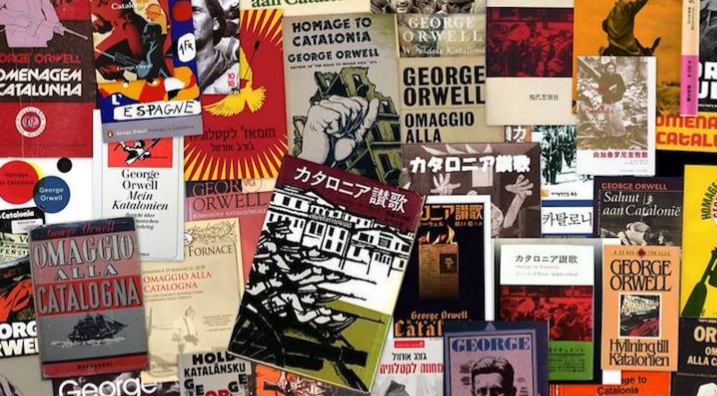
3. Homage to Catalonia (1938)
Summary
A firsthand account of Orwell’s experiences in the Spanish Civil War, focusing on his time fighting against fascist forces.
Key Themes
- War and ideology
- Betrayal within political movements
- Truth vs propaganda
Pros
- Authentic and deeply personal
- Historical significance
Cons
- Complex political context
- Less accessible than fiction
Expert Reviews
Historians consider it one of the most honest accounts of the Spanish Civil War.
Reader Impact
Readers gain a nuanced understanding of political conflict and ideological disillusionment.
4. Down and Out in Paris and London (1933)
Summary
A semi-autobiographical account of Orwell’s life in poverty, working menial jobs and living in harsh conditions.
Key Themes
- Poverty and dignity
- Social inequality
- Human resilience
Pros
- Raw and realistic
- Strong social commentary
Cons
- Episodic structure
- Slower narrative pace
Expert Reviews
Recognized as a foundational work in social journalism.
Reader Impact
Readers often develop a deeper empathy for marginalized communities.
5. Burmese Days (1934)
Summary
Set in colonial Burma, the novel explores the moral decay of British imperialism through its characters.
Key Themes
- Imperialism
- Racism
- Isolation
Pros
- Rich setting
- Strong critique of empire
Cons
- Pessimistic tone
- Less widely read
Expert Reviews
Scholars view it as an essential anti-imperialist text.
Reader Impact
It challenges readers to reconsider colonial history and its legacy.
Analysis of Orwell’s Writing
Orwell’s writing is marked by clarity. He believed that language should be precise, honest, and accessible. In his famous essay Politics and the English Language, he criticized vague and manipulative language—a principle he practiced rigorously.
His works often explore how language can be weaponized. In 1984, Newspeak is designed to limit thought itself. This idea remains deeply relevant in discussions about media framing and digital communication.
Orwell’s realism is another defining trait. Even his dystopian fiction feels grounded because it is rooted in real political systems and human behavior.
Impact and Legacy
George Orwell’s influence extends far beyond literature.
- Language: Terms like Orwellian and Big Brother are widely used.
- Politics: His works are referenced in debates about surveillance and censorship.
- Education: His books are standard texts in schools worldwide.
2026 Updates
- 1984 continues to rank among the most read classics globally, especially amid concerns about AI surveillance and data privacy.
- Academic research in 2025–2026 has revisited Orwell’s ideas in the context of algorithmic governance and misinformation.
- Streaming adaptations and renewed interest in dystopian fiction have brought Orwell to younger audiences.
Criticism of George Orwell
Despite his acclaim, Orwell’s work has faced criticism.
- Political Bias: Some argue his anti-totalitarian stance simplifies complex ideologies.
- Gender Representation: Critics note limited roles for women in his narratives.
- Pessimism: His bleak outlook can feel overwhelming.
However, these critiques often coexist with admiration for his honesty and courage.
FAQs
What is George Orwell best known for?
George Orwell is best known for 1984 and Animal Farm, two of the most influential political novels ever written.
Are George Orwell’s books still relevant in 2026?
Yes. His works are frequently referenced in discussions about surveillance, misinformation, and political power.
Which George Orwell book should I read first?
Animal Farm is ideal for beginners due to its simplicity, while 1984 offers a deeper, more intense experience.
What does “Orwellian” mean?
“Orwellian” refers to situations involving oppressive control, manipulation of truth, and loss of freedom.
Key Takeaways
- George Orwell’s books remain essential reading for understanding power and truth.
- 1984 and Animal Farm continue to shape modern political language.
- His work bridges literature, journalism, and philosophy.
- Orwell’s relevance has only increased in the digital age.
Internal Linking (for your interest)
Conclusion
George Orwell’s books endure because they confront uncomfortable truths. They do not offer easy solutions or comforting illusions. Instead, they hold a mirror to systems of power—and to the individuals who sustain them.
In a world increasingly shaped by invisible forces—algorithms, narratives, and unseen authority—Orwell’s warnings feel sharper than ever. His work demands attention, not as a relic of the past, but as a guide to navigating the present.
To read Orwell is not merely to engage with literature. It is to become more aware, more critical, and perhaps more cautious about the world that continues to unfold.
Thank you for reading!
Stay tuned for more inspiring Books summary, Author’s spotlight, Trend Books & more get full information on TheBooksx.com
About the Author