Satish kumar
 Money is rarely a reward for intelligence, talent, or hard work alone.
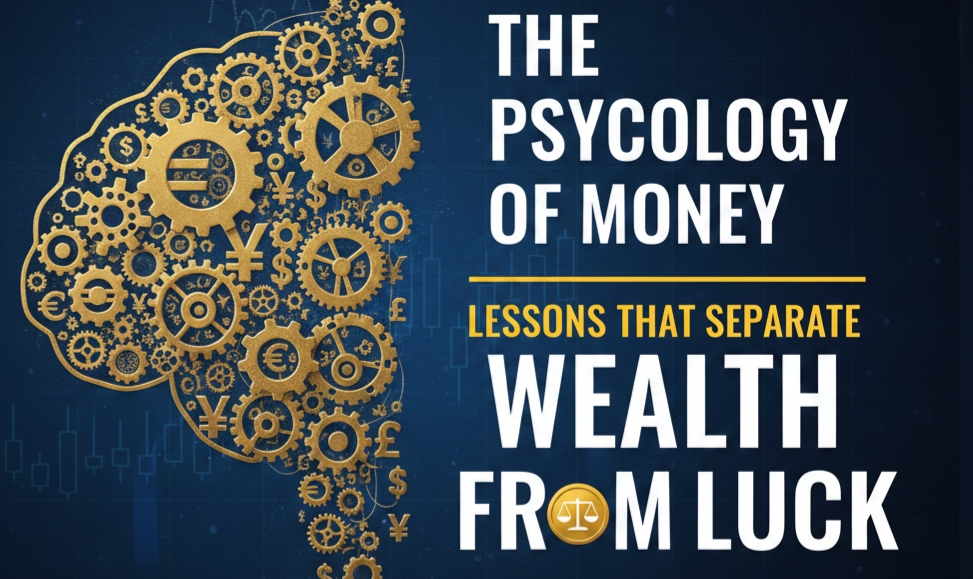
History is full of brilliant people who lost fortunes and ordinary individuals who quietly built lasting wealth. The real difference lies not in numbers or formulas, but in behavior. The Psychology of Money explores this invisible force—the way human emotions, habits, fear, patience, and ego shape financial outcomes far more than spreadsheets ever could.
This book does not promise shortcuts to wealth. Instead, it explains why wealth lasts for some and disappears for others. It draws a clear line between wealth built by discipline and money gained by luck—and why confusing the two is one of the most expensive mistakes people make.
Book Summary: Understanding Money Beyond Math
The Psychology of Money by Morgan Housel is not a traditional finance book. There are no stock tips, no market predictions, and no complex formulas. Instead, it is a collection of short, powerful essays that explain how people actually behave with money—not how textbooks assume they should.
The book argues that financial success depends more on how people think, react, and remain patient than on their technical knowledge. Every financial decision is shaped by personal history, emotional comfort, fear of loss, and expectations formed by luck or trauma.
Housel highlights that people often mistake outcomes for skill, especially during good times. When markets rise, luck is praised as intelligence. When they fall, risk is mistaken for stupidity. The book gently dismantles these illusions, replacing them with timeless principles built on humility, long-term thinking, and emotional control.
Key Lessons That Separate Wealth From Luck
1. Wealth Is What You Don’t See
Luxury cars, expensive watches, and flashy homes are often mistaken for wealth. In reality, true wealth is invisible. It is the money not spent, the time bought back, and the freedom to walk away.
People who look rich may simply be good spenders. People who are wealthy are often quiet, cautious, and underestimated.
Lesson: Building wealth requires resisting the urge to display success.
2. Luck and Risk Are Siblings
Every success story contains a hidden dose of luck, just as every failure includes unseen risk. Ignoring this truth leads to arrogance in good times and despair in bad times.
Housel emphasizes respecting uncertainty. Those who survive financially are not the ones who predict the future—but the ones who prepare for unpredictability.
Lesson: Build margins of safety, not fantasies of certainty.
3. Compounding Rewards Patience, Not Brilliance
The most powerful financial force is not intelligence—it is time. Compounding works quietly, often unnoticed, until it becomes unstoppable.
Many people interrupt compounding by chasing fast gains, reacting emotionally, or abandoning long-term plans too early.
Lesson: Staying invested matters more than making perfect decisions.
4. Behavior Beats Knowledge
Knowing what to do and actually doing it are very different things. Emotional reactions—panic, greed, fear of missing out—destroy more wealth than poor strategies ever could.
People who succeed financially are not immune to emotions; they have systems that protect them from themselves.
Lesson: Control behavior first; strategies come second.
5. Enough Is a Powerful Word
One of the book’s most profound ideas is knowing when to stop. Many financial disasters happen not because people lack money, but because they never define “enough.”
Endless comparison and greed push people to take unnecessary risks long after they’ve already won.
Lesson: Contentment is a financial strategy.
6. Freedom Is the Highest Dividend
Money’s greatest value is not consumption—it is control over time. The ability to choose how to live, work, and think is the true reward of financial independence.
Wealth that traps someone into stress, overwork, or fear of loss is not freedom—it is another form of debt.
Lesson: Money should buy autonomy, not anxiety.
Short Author Introduction: Morgan Housel
Morgan Housel is a financial writer and former columnist for The Wall Street Journal. Known for blending psychology, history, and storytelling, his work focuses on how people behave with money rather than how markets technically operate. His writing stands out for its simplicity, humility, and emotional intelligence—qualities that make The Psychology of Money resonate across generations.
Personal Reflection: Why This Book Feels Uncomfortably Honest
This book does not impress—it humbles. It quietly forces reflection rather than offering motivation. While reading, there is a constant realization that most financial mistakes are not caused by lack of knowledge, but by impatience, ego, or comparison.
What makes The Psychology of Money powerful is its honesty. It does not glorify hustle or overnight success. Instead, it validates slow progress, emotional discipline, and living below one’s means—ideas often dismissed as boring, yet responsible for most long-term wealth.
The book feels less like advice and more like a mirror. It challenges the belief that money is a competition and replaces it with a calmer truth: money is personal, emotional, and deeply human.
Best Quotes from The Psychology of Money
- “Wealth is what you don’t see.”
- “Getting money requires taking risks, being optimistic, and putting yourself out there. Keeping money requires the opposite.”
- “The hardest financial skill is getting the goalpost to stop moving.”
- “You can be wrong half the time and still make a fortune.”
- “Good investing isn’t about earning the highest returns. It’s about earning pretty good returns for the longest period of time.”
Quick Takeaways Table
| Concept | Core Insight |
|---|---|
| Wealth vs Rich | Wealth is savings; rich is spending |
| Luck | Plays a role in every outcome |
| Compounding | Needs time, not brilliance |
| Risk | Always present, often hidden |
| Enough | Prevents unnecessary loss |
Pros & Cons of the Book
Pros
- Timeless principles, not trends
- Simple language, deep meaning
- Suitable for beginners and experienced readers
- Emotion-focused, highly relatable
Cons
- No technical investment guidance
- Repetitive ideas for advanced readers
- More reflective than actionable
Conclusion: Wealth Is a Psychological Game
The Psychology of Money makes one thing clear: money is not a math problem—it is a behavior problem. Those who understand their emotions, respect uncertainty, and remain patient separate lasting wealth from temporary luck.
The book does not promise riches. It offers something far more valuable: clarity. In a world obsessed with more, it quietly teaches how to avoid ruin—and why that alone is success.
Frequently Asked Questions
1. Is The Psychology of Money good for beginners?
Yes. The book avoids technical jargon and focuses on mindset, making it ideal for beginners.
2. Does the book teach investing strategies?
No. It focuses on behavior, decision-making, and long-term thinking rather than tactics.
3. What is the main message of the book?
Financial success depends more on psychology than intelligence or knowledge.
4. Is this book relevant outside investing?
Yes. Its lessons apply to life decisions, risk-taking, and long-term planning.
5. Can this book help avoid financial mistakes?
Yes. It highlights common emotional traps that lead to loss.
6. Who should read this book?
Anyone interested in understanding money beyond numbers—students, professionals, and investors.
About the Author